We design-build and install drainage across Rapid City, Black Hawk, the Black Hills, Custer, and Hot Springs — detention and retention ponds, culvert and headwall installation, catch basins and inlets, French drain and subsurface drainage systems, roadside ditching, and grading for positive surface drainage.
Water is what actually destroys sites and structures in this region. Between clay soils that will not absorb it and Black Hills terrain that concentrates it, drainage is not an afterthought — it is the difference between a dry basement and a claim. Call 605-381-6458.
Drainage and stormwater work we do
From a wet backyard to an engineered stormwater basin for a commercial site:
- Detention ponds — engineered basins that hold and meter out storm flow
- Retention ponds — permanent-pool basins, plus stock and livestock ponds on ag ground
- Culvert installation and replacement — driveway, road, and field crossings sized for actual flow
- Headwalls and end sections — protecting culvert ends from scour and washout
- Catch basins and storm inlets — collecting surface water and tying into storm systems
- French drain systems — perforated pipe in clean rock and fabric to intercept subsurface water
- Foundation and footing drains — keeping groundwater away from basements and crawlspaces
- Ditching and shoulder work — reshaping roadside ditches to carry water instead of ponding it
- Erosion control and rip rap — armoring channels, outfalls, and slopes against washout
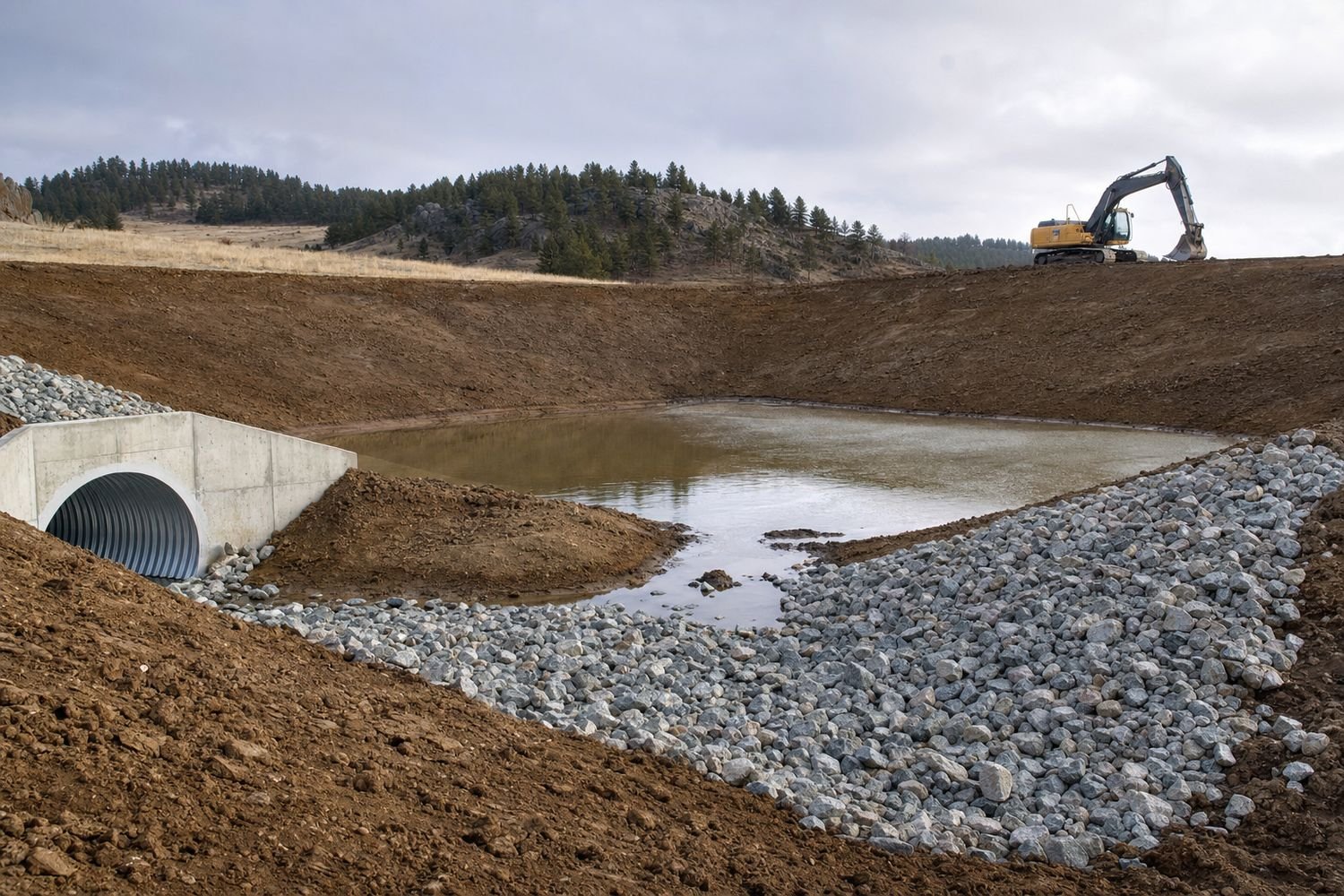
Detention and retention ponds for development
Any project that adds significant impervious surface — a commercial pad, a parking lot, a subdivision of streets and rooftops — sends more water downstream faster than the raw ground did. Stormwater rules exist to hold that back, and detention or retention basins are how it gets done.
We excavate the basin to the engineered volume and contours, build and compact the embankment, install the outlet structure and emergency spillway, armor the inlet and outfall against scour, and stabilize the slopes so the whole thing does not silt in the first season. On ag and ranch ground we also build stock ponds and dugouts, and clean out existing ponds that have filled with sediment.
French drains, footing drains, and wet yards
Surface grading handles surface water. It does nothing for water already moving through the soil, and on a Black Hills lot cut into a slope, that subsurface flow is often the real problem — it shows up as a permanently soggy yard, a wet basement wall, or water pushing under a slab.
A French drain intercepts it: a trench cut on grade, lined with filter fabric, perforated pipe bedded in clean washed rock, and the whole assembly wrapped so it does not silt shut. Done right, with real fall to a legitimate discharge point, it works for decades. Done with the wrong rock, no fabric, or no slope, it clogs in two years — which is why so many homeowners think French drains do not work.
Answers
Drainage, Detention Ponds & Culverts — questions we get asked
What size culvert do I need for my driveway?
Culvert sizing depends on the drainage area feeding it, the slope of the ditch, and the design storm the jurisdiction requires — not on what the neighbor used. Undersized culverts wash out driveways and flood upstream property. On county and state road approaches, the road authority usually specifies the minimum size and the required end treatment. We check the requirement and size it for real flow.
What is the difference between a detention pond and a retention pond?
A detention pond is normally dry. It temporarily holds storm runoff and releases it slowly through an outlet structure, so downstream flow does not spike. A retention pond keeps a permanent pool of water and only discharges when it exceeds its design level. Detention is the more common requirement for commercial stormwater compliance; retention is more common where a permanent water feature or a stock pond is wanted.
Will a French drain fix my wet basement?
It often will, if subsurface water is the cause. Before recommending one we look at whether the grading around the house actually falls away from the foundation, where the gutters and downspouts discharge, and whether there is an uphill source feeding the wall — because fixing grade and downspouts is cheaper than installing pipe. If subsurface flow is the real source, a properly built French drain or footing drain with a legitimate discharge point is the durable fix.
Do you clean out existing ponds and ditches?
Yes. Sediment fills basins and flattens ditches over time until they stop working. We clean out detention basins and stock ponds, reshape and re-grade silted-in ditches, restore ditch fall, repair damaged culvert ends and headwalls, and re-armor outfalls that have scoured.
Service Area
Drainage, Detention Ponds & Culverts across western South Dakota & Wyoming
We provide drainage, detention ponds & culverts throughout our full service area.
- Rapid City, SD
- Black Hawk, SD
- Custer, SD
- Hot Springs, SD
- Gillette, WY
- Philip, SD
- Black Hills
Related
Often paired with
Road Building & Road Maintenance
Subdivision streets, private drives, ranch and haul roads — built, crowned, and maintained.
Learn moreWater, Sewer & Storm Sewer Installation
Water main, sanitary sewer, storm sewer and service laterals — installed, tied in, and backfilled right.
Learn moreGrading & Site Preparation
Building pads, cut and fill, mass excavation, and finish grade you can build on.
Learn moreNeed drainage, detention ponds & culverts?
Call Jason at 605-381-6458 or email jason@unlimitedgrading.com. Free on-site estimates across Rapid City, the Black Hills, and Gillette.