Unlimited Grading & Utility LLC places and compacts structural fill for building pads, roadways, and backfill throughout Rapid City, Black Hawk, and western South Dakota. We undercut and remove unsuitable material, import select fill where the native soil will not perform, place it in controlled lifts at proper moisture, and compact each lift before the next one goes on.
This is the part of earthwork that decides whether a slab cracks in year three. On expansive clay ground like ours, fill that was never moisture-conditioned or never got real compactive effort is the single most common cause of foundation movement. Call 605-381-6458.
Fill and compaction work we perform
Whether you are handing us a geotechnical report with a target density or you just need a shop pad that will not move, the sequence is the same:
- Undercut and removal of unsuitable material — organics, soft clay, and debris taken out below the pad
- Structural fill placement — select material placed in controlled lifts to design elevation
- Moisture conditioning — fill watered or dried back to the moisture range where it will actually compact
- Compaction to specification — sheepsfoot, smooth drum, and plate compaction sized to the material and the lift
- Backfill and trench compaction — utility trenches, foundation walls, and retaining structures
- Aggregate base and subbase placement — graded and compacted base under slabs, pavement, and gravel surfaces
- Import and export of fill — bringing in select material or hauling off surplus and spoils
- Proof rolling and testing coordination — working with your testing lab so density gets documented
Working with expansive clay soils
Much of the ground around Rapid City includes expansive clay that changes volume with moisture. Build a slab on top of clay that was compacted dry and it will heave when it eventually takes on water. Compact it too wet and it never reaches density and consolidates under load instead.
The fix is not exotic, it is discipline: get the material into its moisture window, put it down in lifts thin enough that the compactor's energy reaches the bottom of the lift, and verify as you go. Where the native clay is simply too poor to build on, the right answer is to undercut it and replace it with imported granular fill, and we will tell you when that is the case.
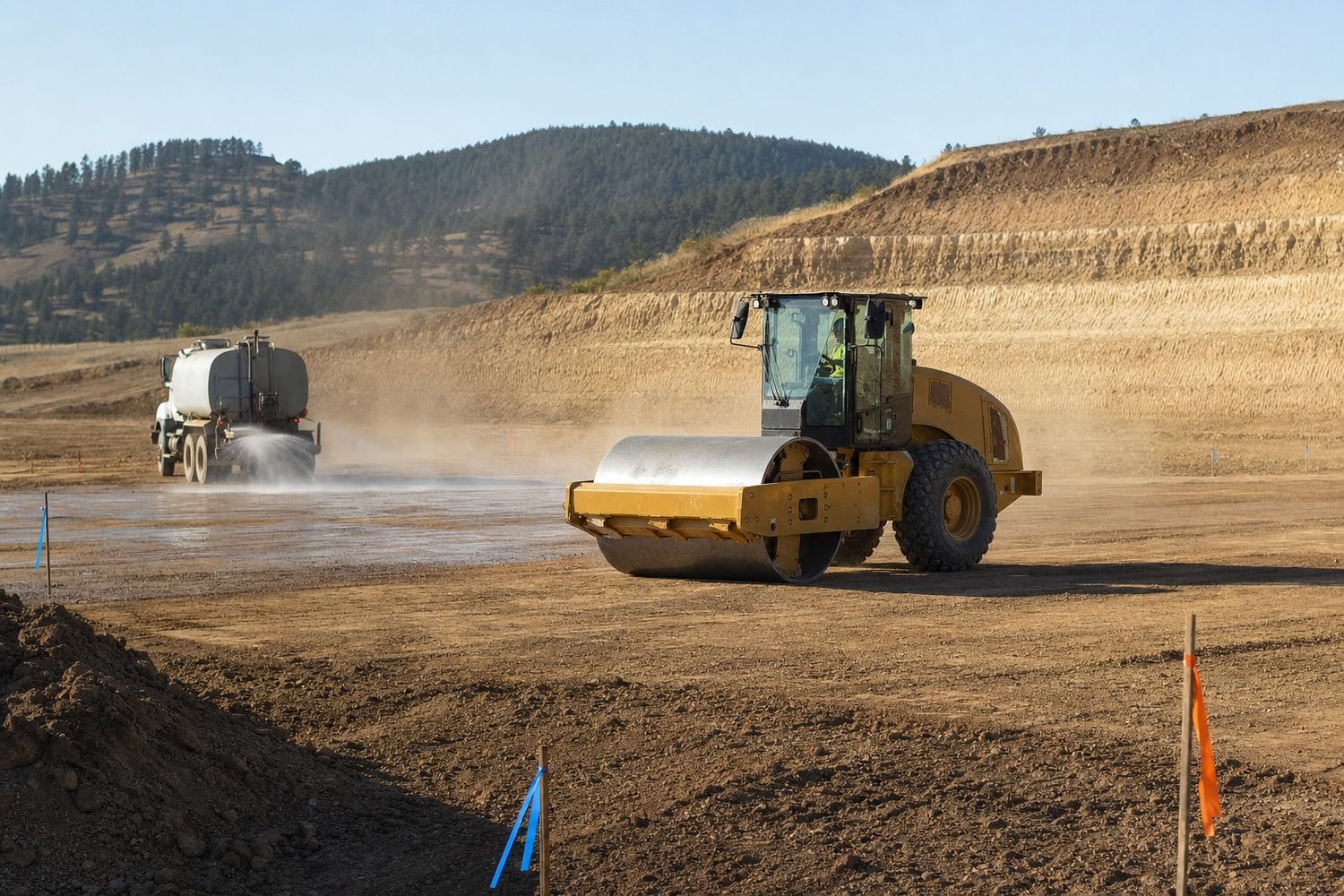
Documented compaction for inspectors and engineers
On engineered projects, density has to be proven, not asserted. We build to the specification in your geotech report, schedule around your testing lab so nucleon density tests happen at the right lifts, and stop and rework a lift that fails rather than burying it. If you need pad certification for a lender, an inspector, or a structural engineer, we work within that process.
Answers
Structural Fill Placement & Compaction — questions we get asked
What is structural fill and how is it different from regular fill?
Structural fill is material selected and placed specifically to carry load — it is a known, compactable material placed in controlled lifts and compacted to a target density. Regular fill is just material used to take up space, often placed loose and not tested. You can put general fill in a landscape berm. You cannot put it under a footing or a slab and expect the structure to stay where you built it.
How is compaction measured?
Compaction is usually specified as a percentage of maximum dry density from a Proctor test on that specific material — commonly 95 percent of standard Proctor under building pads and roadways. Field density is verified with a nuclear density gauge or sand cone test by a testing lab. We build to the spec in your plans or geotech report and coordinate testing so the numbers are on record.
How thick should each lift be?
Lift thickness depends on the material and the compactor. Typical engineered fill goes down in six to eight inch loose lifts for the compaction equipment used on most sites in this area. Thicker lifts look faster but the compactive energy does not reach the bottom, which leaves a soft layer buried in the middle of your pad.
Can you fix a pad that was already built wrong?
Frequently, yes — and it is far cheaper to fix before the concrete goes down than after. We proof roll to find the soft areas, undercut and replace what is failing, and rebuild the affected lifts to spec. If a slab or footing is already in place and moving, that becomes a structural repair question and you will want an engineer's assessment before anyone moves dirt.
Service Area
Structural Fill Placement & Compaction across western South Dakota & Wyoming
We provide structural fill placement & compaction throughout our full service area.
- Rapid City, SD
- Black Hawk, SD
- Custer, SD
- Hot Springs, SD
- Gillette, WY
- Philip, SD
- Black Hills
Related
Often paired with
Grading & Site Preparation
Building pads, cut and fill, mass excavation, and finish grade you can build on.
Learn moreWater, Sewer & Storm Sewer Installation
Water main, sanitary sewer, storm sewer and service laterals — installed, tied in, and backfilled right.
Learn moreRoad Building & Road Maintenance
Subdivision streets, private drives, ranch and haul roads — built, crowned, and maintained.
Learn moreNeed structural fill placement & compaction?
Call Jason at 605-381-6458 or email jason@unlimitedgrading.com. Free on-site estimates across Rapid City, the Black Hills, and Gillette.