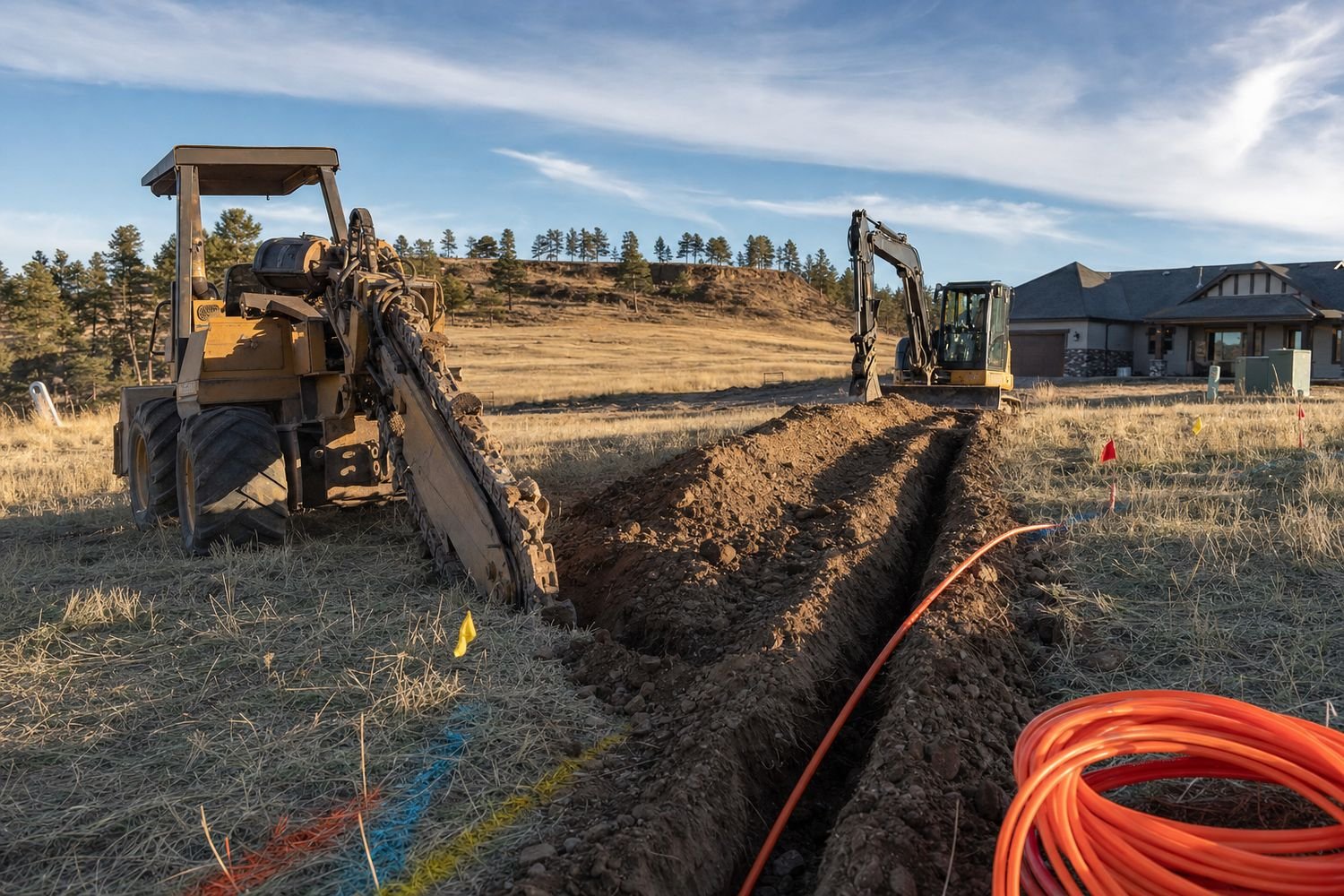
We cut, bed, and backfill utility trench for electrical power, fiber, and communication conduit across Rapid City, Black Hawk, the I-90 corridor, and the wider Black Hills. That includes single-purpose electrical trench, common utility trench carrying power, gas, water, and comm in one excavation, service runs to homes, shops, and outbuildings, and trenching for site lighting, irrigation, and pivot power on ag and ranch ground.
We work to the depth and separation your utility provider requires, place bedding sand or clean rock where conduit needs it, install warning tape, and compact the trench in lifts. Call 605-381-6458 to get on the schedule.
Trenching work we take on
Trenching sounds simple until the trench has to satisfy four different utility inspectors. We handle:
- Primary and secondary electrical trench — transformer pads to service, cut to utility-specified depth
- Fiber and communication conduit — telecom, broadband, and low-voltage runs with proper bedding and tracer
- Common utility trench — power, gas, water, and communications sharing one excavation with required separation
- Service runs to outbuildings — shops, barns, wells, pumps, gates, and site lighting
- Boring pits and receiving pits — excavated and shored for directional drill crews
- Road and driveway crossings — cut, sleeved, backfilled, and surface restored
- Trench backfill and compaction — placed in lifts to prevent settlement
- Rock trenching — hammer and rip through shallow bedrock where a trencher will not go
Trenching in a growth corridor
New subdivisions along the I-90 corridor through Black Hawk, Summerset, and Piedmont, and new lots east toward Box Elder and Rapid Valley, all need the same thing before a house goes vertical: power and communications in the ground. We work as a subcontractor to electricians, utility providers, and general contractors, and directly for owner-builders and developers running their own site.
Because we also do the grading and the water and sewer, we can sequence the whole underground package in one pass instead of having three outfits digging across each other's work.
Rock, frost depth, and doing it once
Two things drive trenching cost in this region. The first is rock — across much of the Black Hills you are into weathered granite, limestone, or hardpan within a few feet, and a chain trencher will stall where a hydraulic hammer and an excavator will not. The second is frost depth: water lines sharing a trench have to be deep enough to stay below the frost line, which sets the depth for everything in a common trench.
We plan the trench around the hardest constraint rather than the easiest, which is why our trenches pass inspection the first time.
Answers
Utility Trenching for Power & Communications — questions we get asked
How deep does a utility trench need to be?
It depends on what is in it and who owns it. Primary electrical, secondary service, gas, communications, and water all have their own minimum cover requirements, and a common trench has to satisfy the deepest of them plus the required vertical and horizontal separation between services. Water lines in western South Dakota also need to sit below frost depth. We confirm the requirement with your utility provider before we cut so nothing gets dug twice.
Can you trench through rock?
Yes. Where a trencher stalls out we switch to an excavator with a hydraulic hammer or ripper and cut through weathered granite, limestone, and hardpan. Rock trenching is slower and priced accordingly, so we probe conditions during the site walk instead of finding out at hour three.
Do you dig the pits for a directional boring crew?
Yes. We excavate and shore entry and receiving pits for horizontal directional drilling crews, handle spoil, and backfill and compact the pits after the bore is pulled. On projects where boring is the smarter approach — under a paved road, a mature tree line, or an existing structure — we will say so rather than open-cutting through something that should not be cut.
Will the trench settle after backfill?
Not if it is done correctly. Settlement happens when backfill is pushed in loose and left to consolidate on its own. We place backfill in lifts and compact each one, and we bring the surface back with the right material — topsoil, aggregate, or a proper patch — so the trench line does not show up as a sunken stripe next spring.
Service Area
Utility Trenching for Power & Communications across western South Dakota & Wyoming
We provide utility trenching for power & communications throughout our full service area.
- Rapid City, SD
- Black Hawk, SD
- Custer, SD
- Hot Springs, SD
- Gillette, WY
- Philip, SD
- Black Hills
Related
Often paired with
Water, Sewer & Storm Sewer Installation
Water main, sanitary sewer, storm sewer and service laterals — installed, tied in, and backfilled right.
Learn moreGrading & Site Preparation
Building pads, cut and fill, mass excavation, and finish grade you can build on.
Learn moreStructural Fill Placement & Compaction
Engineered lifts, moisture-conditioned and compacted to spec — pads that hold.
Learn moreNeed utility trenching for power & communications?
Call Jason at 605-381-6458 or email jason@unlimitedgrading.com. Free on-site estimates across Rapid City, the Black Hills, and Gillette.